
Performance is not a
personality trait.
It is a system.
When someone consistently makes sharp decisions under pressure, learns new things quickly, or stays focused when everyone around them is distracted, we tend to assume they are “just built that way”, as if that was a fixed trait.
.The science says otherwise. Decades of research into neuroplasticity, beginning with Michael Merzenich's work in the 1980s and later confirmed by studies across cognitive neuroscience and developmental psychology, show that what looks like natural ability is almost always the result of a brain that has developed specific skills. Sometimes deliberately. More often by accident.
The difference between someone who performs at a high level and someone who does not is rarely their initial intelligence. Carol Dweck's research at Stanford showed that cognitive performance is far more determined by developed skill than by fixed ability, and that the brain continues forming new neural connections in response to deliberate practice well into adulthood.
Understanding how the brain actually works is the first step to changing how it performs.
THE THREE LAYERS OF PERFORMANCE
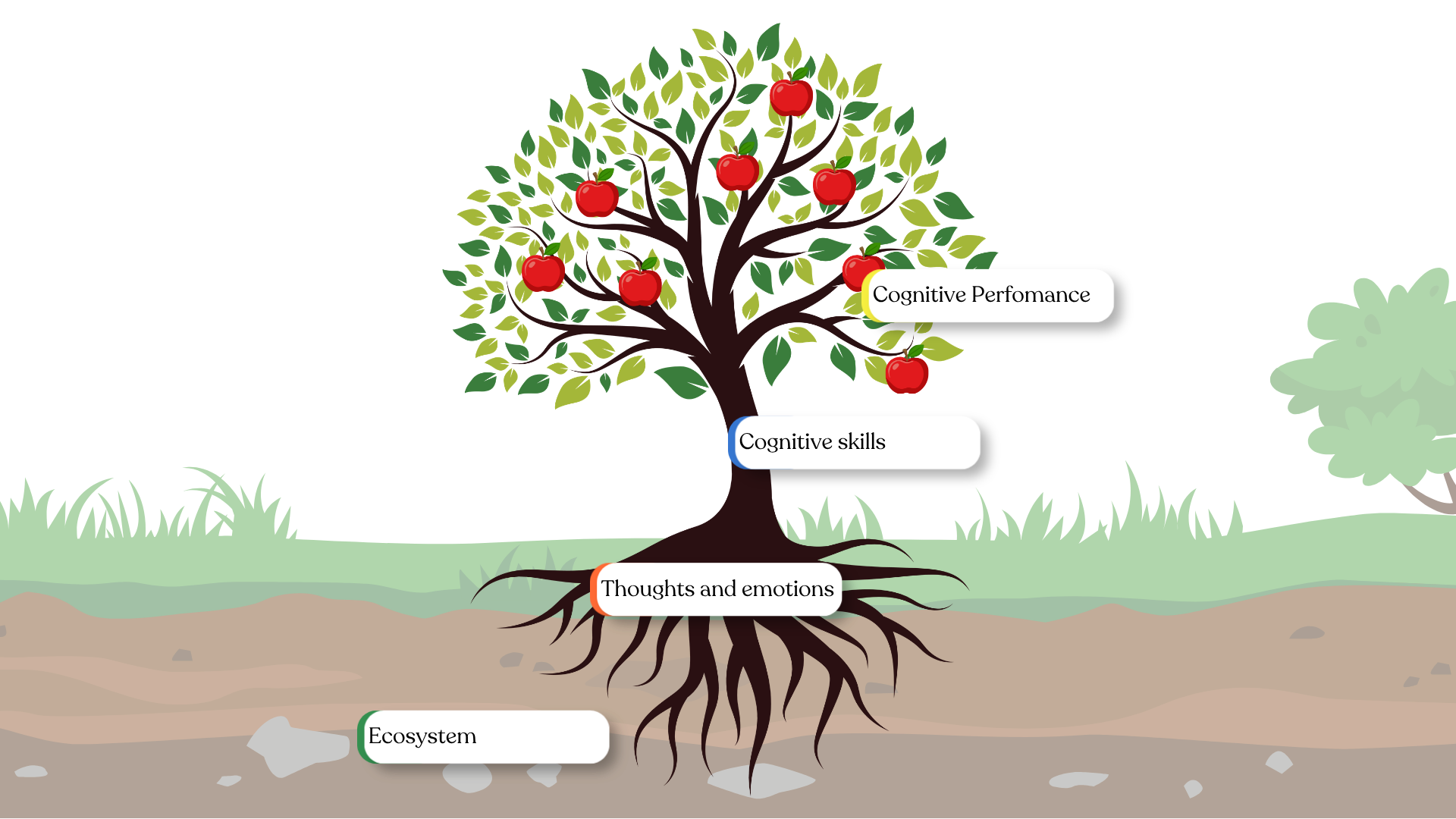
Think of your performance
as the fruit of a tree.
Most people focus entirely on the fruit: the results, the revenue, the output, the grades, the growth. But fruit is the product of everything happening deeper in the system. There are three layers that determine how well any brain performs.
Your thoughts
THE ROOTS
The roots are invisible, but they feed everything above. Limiting beliefs, unexamined assumptions, and automatic patterns of self-talk quietly shape every decision and every moment of focus, long before conscious effort gets a chance.
Research into the brain's default mode network, the system activated during self-referential thought, shows that chronic negative internal patterns are associated with reduced executive function, the cognitive system responsible for planning, decision making, and learning. (Buckner et al., 2008; Beck, 1979). Matthew Lieberman's work at UCLA adds another layer: simply labelling an emotional state activates the prefrontal cortex and reduces amygdala reactivity, which means the way we talk to ourselves about our own performance has a direct, measurable effect on the brain's ability to think clearly.
This is why two people can receive identical training and produce very different results. The visible work is the same. What differs is what is happening underground.
Sustainable change always starts here.
Cognitive skills
THE TRUNK
This is where the trainable work happens. Focus, critical thinking, decision making, memory, time management, and more. These skills determine how effectively a brain operates when it matters most.
They are not fixed traits. Anders Ericsson's research on deliberate practice, the foundation of what is now widely known as the 10,000 hours principle, demonstrated that expert performance in any domain is the result of structured, feedback-rich skill development, not innate talent. His findings have since been replicated across domains from music and chess to surgery and sport.
At the neurological level, the mechanism is well established. Each time a cognitive skill is practised with appropriate challenge and feedback, the relevant neural pathways are reinforced through myelination, a process in which the myelin sheath around nerve fibres thickens, making transmission faster and more reliable. The brain physically changesin response to deliberate practice. That is not a metaphor. It is measurable anatomy.
That is the mechanism everything at inGeniusly is built on.
The ecosystem
THE ENVIRONMENT
Even the strongest trunk cannot perform well in poor soil. Sleep, hydration, movement, nutrition, and recovery are not wellness add-ons separate from performance. They are the biological conditions that determine whether the brain has the resources to think at its best on any given day.
Matthew Walker's research at UC Berkeley on sleep and cognition found that a single night of poor sleep reduces prefrontal cortex activity by up to 30%, effectively impairing the precise cognitive functions that training is designed to develop. Similarly, research on the gut-brain axis has established measurable links between nutrition, inflammation, and cognitive processing speed.
A well-trained skill degrades under chronic sleep deprivation. A sharp mind dulls when the body is consistently under-resourced.
The ecosystem does not replace cognitive training, but it determines how fast training works and how well the results hold.